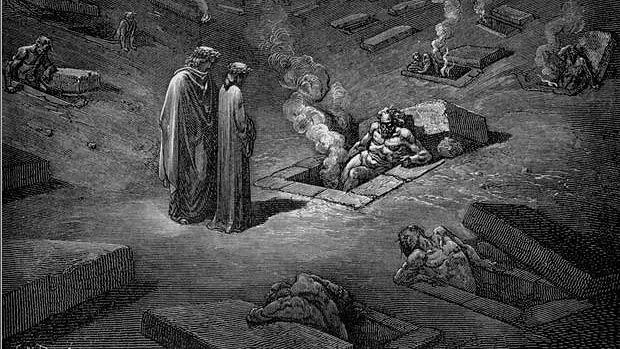
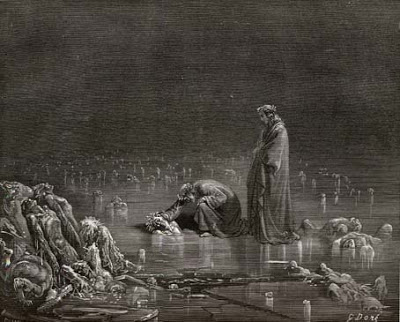
[Gustave Doré, The Heresiarchs (1890)]
Now I lay me down to sleep,
I pray the Lord my soul to keep,
If I shall die before I wake,
I pray the Lord my soul to take. Amen.
I am going to Hell. At this point in my life, I’m fairly certain of this fate. Of course, that’s if Hell actually exists.
If it exists, I certainly hope it’s as twisted and tormented as Dante makes it out to be. Because then I’d have some eternal entertainment to go along with my eternal damnation.
For most of my life I thought it was an absolute certainty I’d be going to Heaven. It was a belief grounded in my relatively intact set of morals, which I picked up from a childhood of Christian indoctrination. As in, “thou shalt not kill.”
Even on my worst days, I have definitely never killed anyone. Obviously, this is a solid step in the direction of Heaven for most people. And I took many other steps in that direction for a significant portion of my life. As a child, I even thought it would be cool to be a priest.
I was raised in a Catholic household, went to church every Sunday, believed in God, said my prayers, went to confession, and received communion. Then I went to college, started sleeping in on Sundays, and only made it to church when I was home on vacation. Yet, I still believed in God, that my relatively moral lifestyle was the foundation for a good life, and enjoyed asking God for things of a miraculous nature.
For example, one of my favorite requests went something like, “Dear God, this workout is killing me. Don’t let me die on the elliptical machine.”
Once I started grad school, I started making a real attempt to go to church more regularly, as way of accepting a mature lifestyle, and establishing myself in the community.
When I moved to Boston, I started going to church more regularly, bolstered by the belief that I had found my purpose in life… But that was back in 2004 and the Catholic Church was just beginning to endure the greatest assault it has ever faced. The assault was coming from every angle, even from within. As the accusations of sexual abuse started multiplying and became reality, I was in the midst of the greatest transformation of my life.
I began to have faith in myself.
The same level of faith it takes to believe there is a higher power, someone or something who has pre-destined each of our lives, was the amount of faith I had swept over me and my ability to transform my own life. This level of faith made me begin to question a lot of the certainties I had in my life, not only about religion, but about who I wanted to become, how I could do it, and what it would take.
A lot of things have happened between then and now in my life. Some good. Some bad. But for the most part, the past decade has been a whirlwind of self-discovery. However, my willingness to question what I have believed about religion, God, and faith definitely sits atop my list.
—–
Not that long ago, before I started my medical residency, I was working overnight at the Amazon warehouse in Lexington, KY. Early one morning, around 2AM, a 21-year-old young man was across the conveyor belt from me when he struck up a conversation. I had seen him around before and noticed that during our brief 15 minute breaks he would be reading the Bible. On this night, our chit-chat quickly moved to the most engrossing discussion on religion I have ever experienced.
It didn’t take long for me to recognize this guy had thoroughly delved into the Bible and his knowledge of scripture was as impressive as any Sunday morning sermon I’ve ever heard. But his story, the one that led him to give himself to God, was the final piece of the puzzle in my religious self-discovery.
He told me how he had grown up in a misogynistic home, one where he was taught to do as he wished and pleased, to use sex and drugs to make himself feel good, and to ignore the role of education and morals in his life. He was infinitely atheist, often openly mocking acquaintances and classmates, even friends, who entertained the idea of a higher power.
But at age 19, with his two-year old son, born of a drug-laden sexual tryst, at his side, he gave himself to God.
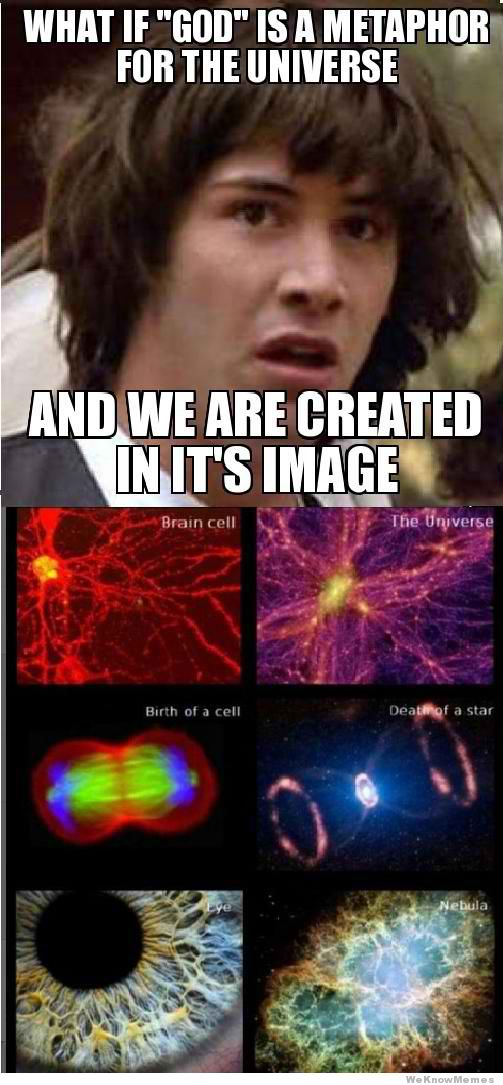
His girlfriend was pregnant with his next child and he was beginning to feel overwhelmed with the future. He described looking at his son one night, becoming overcome with grief, falling to his knees, and beginning to cry profusely. Then, he felt the hand of God on his shoulder, could hear Him speaking in his ear, and a wave of emotion poured over him.
Moments later, he was irreparably changed. He felt a purpose in his life and a desire to live with a moral certitude. He felt “saved”, as if there was someone else looking out for him and asking him to be a better person. The thought of his eternal salvation came to mind. So he dedicated his free time to his family and his religious education.
From the way he described himself prior to this experience, I could tell a completely different man was standing across from me on an early morning in late May. The difference between him and I, though, was that he believed God had changed his life, while I understood that he, and he alone, had made a decision; the decision to no longer be an irresponsible child, trying to raise a child of his own, and to instead become a grown adult.

In my mind, there is no spiritual mystery to maturation.
—-
The understanding of the human body I have acquired during my medical education is an easy scapegoat for my drift away from God and/or religion. But truth be told, my beliefs were changing long before I understood the electrical underpinnings involved in a heartbeat, the diffusion capacity of a pneumocyte in the lung, or the capability of an egg to be fertilized by sperm.
My medical knowledge has played a role, but not as great as it might seem. I have actually entertained the reality that my belief in science, the platform on which medicine is based, is not mutually exclusive from religion. Many people think a true belief in science, or more accurately, the scientific method, prevents one from acknowledging a God. I don’t necessarily believe that is the case.
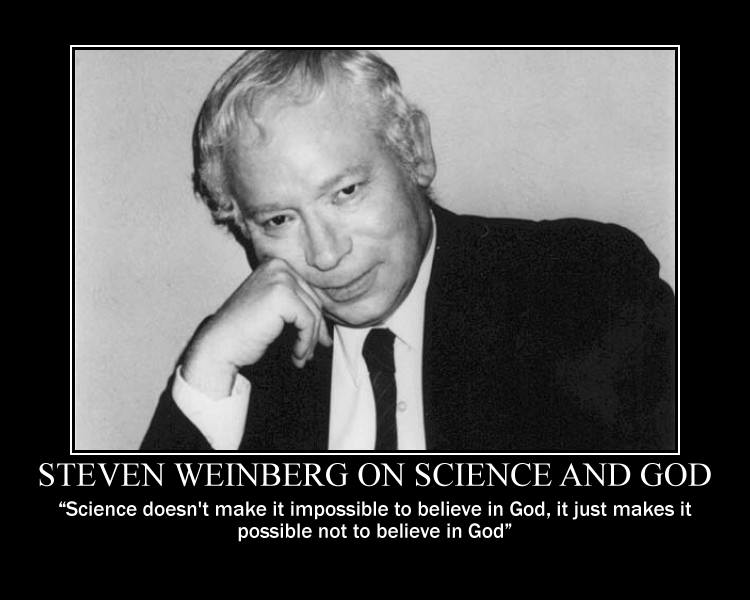
“Finding Darwin’s God” by Kenneth R. Miller, is one of the most influential and thought-provoking texts I’ve read in the past 10 years. In it, he lays a quite convincing thesis for the co-existence of God and Science. In fact, he argues the “miracle of life” known as creation is not mutually exclusive from the acknowledgement of evolution. He argues it may actually speak to the wonderful power of a creator; one that has set the world in motion, but is allowing it to be self-defined.
Self-defined. Like each and every one of us.
—-
As I laid out my thesis against his belief in God, the young man at Amazon pointed out he had at one time felt exactly the same way. Until the fateful day in his life when he was saved. When God revealed Himself and changed the young man’s understanding of the world and his life.
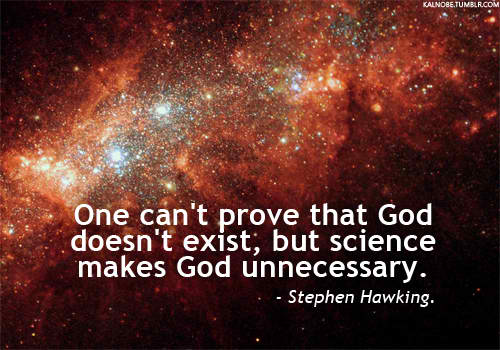
When the young man expressed it as his destiny, one that had been pre-determined, I pointed out if his God is real and controlling my life, then my life is pre-destined, and I truly have no say in whether I end up in Heaven. Or Hell.
And if that is the case, then I am on a Highway to Hell. Because the God of Christianity requires a belief in Him to be saved. There are no keys to the kingdom of Heaven to those of us who have chosen to place our faith in the belief we have control of our lives; control of who we become and our ability to make it happen through sheer willpower and effort.
Faith is not exclusive to those who have religion in their lives. Some of us have faith there is nothing waiting for us after our hearts stop beating. And that faith allows you to embrace the world, its challenges, its heartbreak, and its rewards more than the holiest of thou.
Of course, I could be wrong. And then I’ll end up in Hell. But rest assured, Dante and I will have a quite a party down there. At the very least, I’ll spend the rest of eternity trying to convince Lucifer to apologize to the Man Upstairs.
 Elbrecht's Corpuscle
3 comments